Every time you flip on your favorite show, charge your phone, or crank the AC on a scorching afternoon, you’re relying on one of the largest, most complex machines ever built: the power grid. Most of us never think about it until it stops working, but understanding how the grid functions can help us make sense of why outages happen, why some regions face bigger reliability issues than others, and what role you play as an energy consumer.
In this article, we’ll cover what the electric grid actually is, how electricity travels from a power plant to your home, how the U.S. power grid is organized, and the challenges that keep grid operators — and energy-conscious consumers — busy working toward solutions.
What is the power grid?
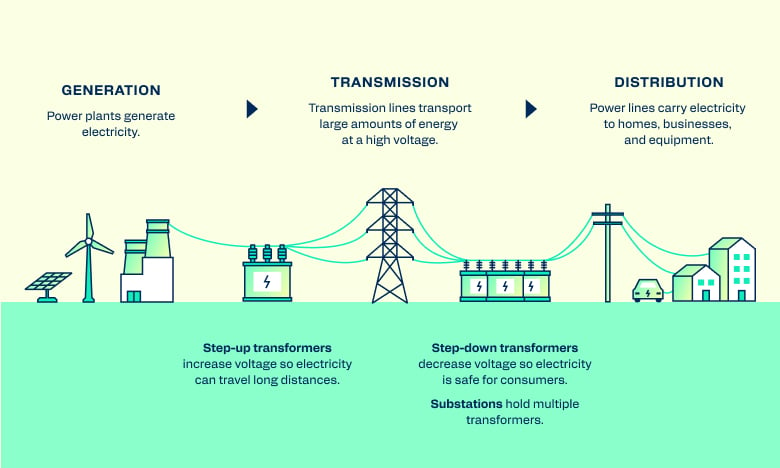
The power grid is the vast, interconnected system that takes energy from its source and delivers electricity to homes and businesses. It starts with energy sources — natural gas, coal, nuclear fuel, wind, sunlight, and flowing water — that are converted into electricity at generating facilities, or power plants. From there, high-voltage transmission lines carry that electricity over long distances, substations adjust its voltage for safe distribution, and local distribution lines deliver the power to your home or business. Think of it as a vast web of infrastructure, all working together in real time to keep the lights on, no matter where you are.
VIDEO: How does the power grid work?
How does the power grid work?
Getting electricity from a power plant to your home happens in three stages: generation, transmission, and distribution.
Stage 1: Generation
Electricity begins at the source — a natural gas plant, a wind farm, a solar array, a dam, or a nuclear reactor — where energy is converted into electrical current and sent out onto the grid. The grid draws from many of these sources at once, which means the energy powering your home at any given moment is likely a blend of several of them, shifting quietly in the background as demand rises and falls throughout the day.
Stage 2: Transmission
Once electricity is generated, it often has to travel hundreds of miles to reach the communities and people that need it. Moving electricity at high voltage makes long-distance transport far more efficient, reducing how much energy is lost and how much it costs to deliver. Transmission lines are built for that exact purpose. Think of them as the grid’s highway system: built wide and fast to move large amounts of electricity across vast distances before it ever reaches your neighborhood.
Stage 3: Distribution
This is where electricity finally reaches you. At substations along the transmission lines, transformers reduce that high-voltage electricity to lower, safer levels — the 120 volts that power your appliances and electronics at home. From there, local distribution lines, whether running along your street or buried underground, carry electricity the last mile into your home or business.
This entire process happens continuously — 24/7/365. Keeping the grid stable and reliable means that grid operators must constantly match electricity supply to demand in real time — a balancing act that plays out every second of every day.
How many power grids are in the U.S.?
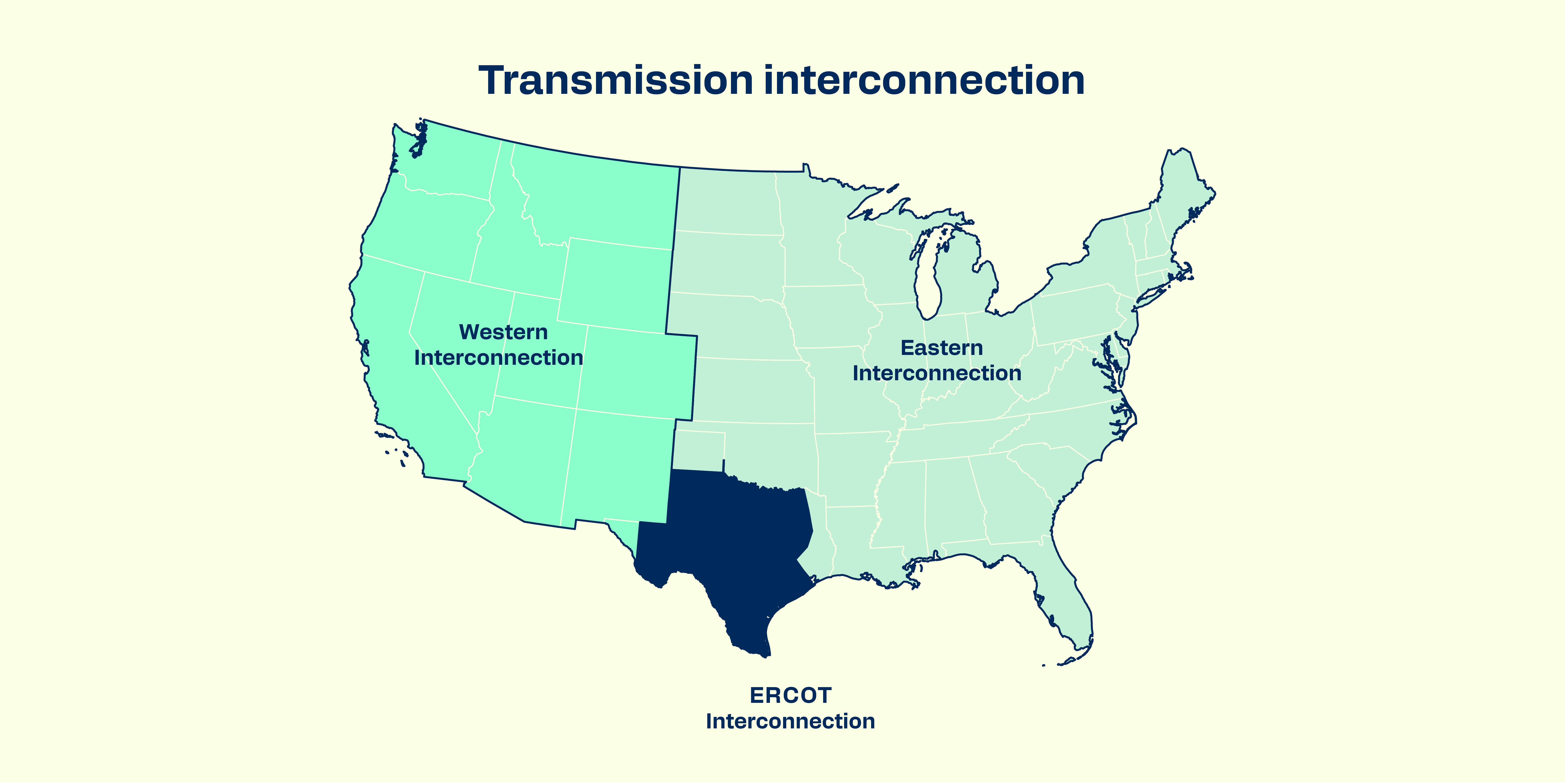
Myth: the U.S. runs on one single, unified power grid. Fact: the country’s electricity system in the Lower 48 states is split into three main interconnections, and each operates largely on its own.
Eastern Interconnection
The Eastern Interconnection is the largest of the three, covering the area east of the Rocky Mountains, including a portion of the Texas panhandle. It serves the majority of the country’s population, stretching from the Great Plains to the Atlantic coast.
Western Interconnection
The Western Interconnection covers the area west of the Rocky Mountains to the Pacific coast, spanning the nation’s western states including California, Washington, Arizona, and Colorado. It’s also linked to parts of Canada’s power grid.
ERCOT (Texas Interconnection)
The Electric Reliability Council of Texas (ERCOT) covers most of the state of Texas. Texas built its own, largely self-contained grid in part to stay outside of federal interstate regulation. In practice, that independence means Texas has limited ability to import large amounts of power from neighboring states during an emergency — a limitation that made national headlines during Winter Storm Uri in 2021, when the state’s isolated grid struggled to keep up with a historic cold snap.
This three-way split isn’t arbitrary — it’s the product of history, regulation, and geography. In the early 1900s, thousands of small, independent electric utilities operated across the country. As demand for electricity grew, especially after World War II, those independent utilities began connecting their systems to share the cost of building large power plants and to reduce the extra generating capacity each one needed to keep on hand for peak demand. Over time, those connections consolidated into the three interconnections.
The tradeoff? These interconnections mostly operate independently and rarely transfer significant power between one another. While this keeps each system’s day-to-day operations simpler, it also limits how much backup power can flow across interconnection boundaries during extreme weather or high-demand events. That means if your region’s interconnection is under strain, help from a neighboring interconnection may not be able to reach you as quickly as you’d hope — which is exactly what played out in Texas during Winter Storm Uri.
What factors threaten the electric grid?
The grid is one of the most critical pieces of infrastructure in the country. It’s also one of the most vulnerable. Let’s explore the factors putting grid reliability at risk, and what it means for you.
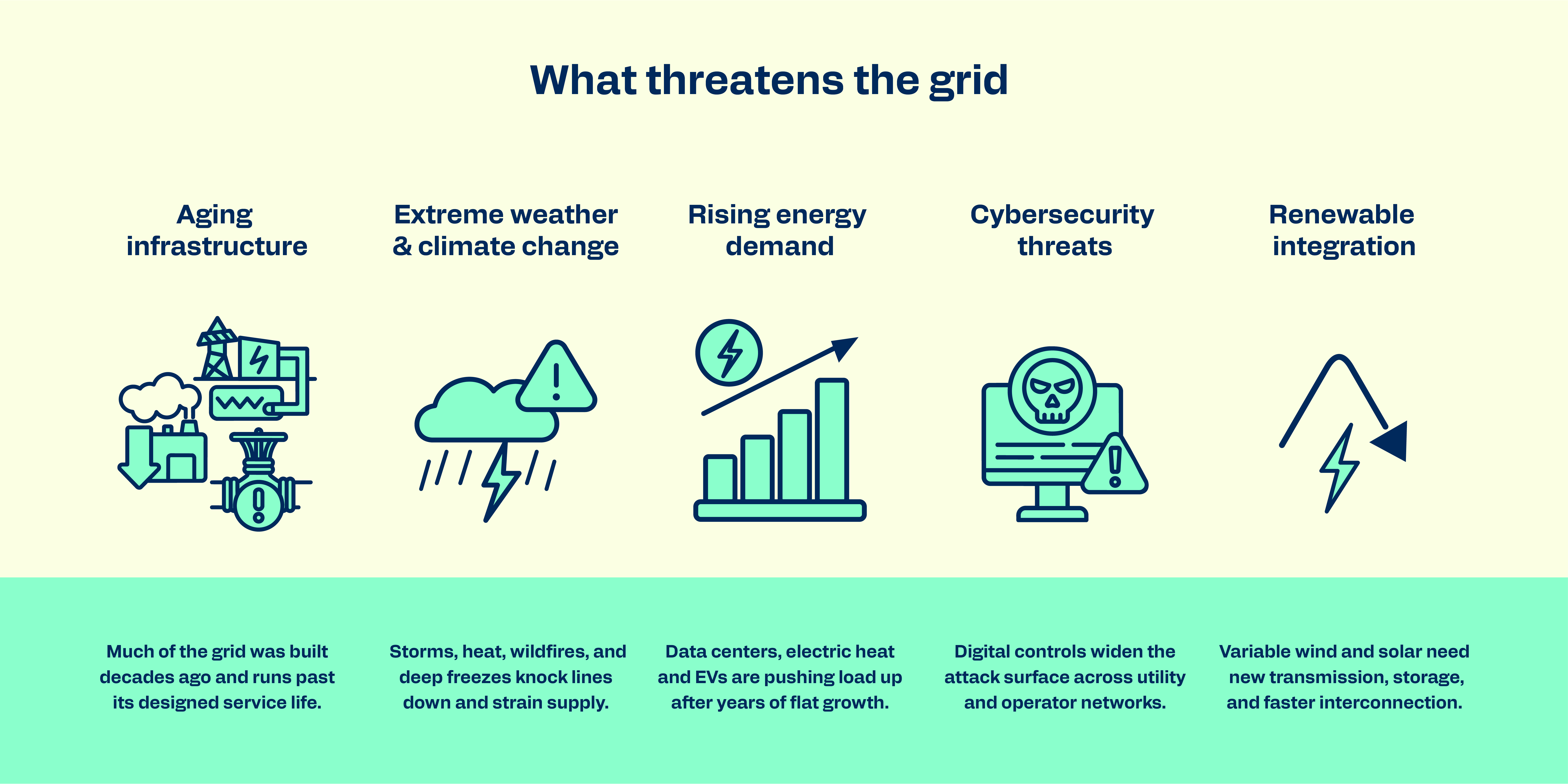
Aging infrastructure
Much of the modern U.S. grid was built in the 1920s and ‘30s. There was no way to account for today’s demand levels or a complex, digitally connected energy system. Aging equipment is prone to failure and expensive to maintain and replace. Today, more than 70 percent of the nation’s power transformers and transmission lines are over 25 years old, and roughly 60 percent of circuit breakers are more than 30 years old. That aging infrastructure is a primary reason the American Society of Civil Engineers (ASCE) gave U.S. energy infrastructure a D+ in its 2025 Infrastructure Report Card.
Extreme weather and climate change
Severe weather is the single largest cause of power outages in the nation. According to ASCE, weather events (heat waves, winter storms, hurricanes, and wildfires) were responsible for roughly 80 percent of U.S. power outages between 2000 and 2023. What’s more, the country experienced about twice as many weather-related outages in the most recent decade (2014–2023) as it did in the decade before. Aging equipment is especially vulnerable to weather-related stress.
Rising energy demand
Electricity demand is accelerating. Population growth, electric vehicle adoption, and home heating needs, and a boom in data centers are all adding pressure to a grid that was not built to accommodate this level of demand. Data centers are a significant part of that story — they consumed enough electricity in 2022 to power 17 million average American homes, and that figure is expected to double by 2030. ASCE’s report also projects that summer and winter peak demand will each grow by 15 to 18 percent by 2034. For customers, that trajectory means a higher risk of outages and price spikes, especially during periods when the grid is already under the most strain.
Cybersecurity threats
The modern grid runs on digital infrastructure — smart meters, automated substations, and networked control systems — making it an increasingly attractive target for cyberattacks. Federal agencies like the Cybersecurity and Infrastructure Security Agency (CISA) classify the energy sector as uniquely critical infrastructure, and for good reason: a successful attack could cut power to homes, hospitals, and businesses across entire regions. That risk is why utilities and regulators continue to invest heavily in digital defenses.
Integration of renewable energy
Renewable energy sources like solar and wind are a critical part of the grid’s future — but they come with a built-in challenge: they can’t generate power on demand. The grid was originally designed around large, steady, controllable power plants, and operators must constantly rebalance electricity supply and demand to keep it stable, sending adjustment signals as often as every few seconds. The natural variability of wind and solar power makes that balancing act harder. In regions without sufficient energy storage or backup capacity, gaps between when power is generated and when it’s actually needed can strain the system.
Curious how modern technology is helping the grid address these threats? Learn how smart grid technology is supporting grid infrastructure.
How everyday customers can support the grid
These pressures facing the grid aren’t distant, infrastructure-level problems — they show up in your electricity bill, in outages during heat waves, and in the reliability of power to your home. But individual actions add up. Simple habits like shifting energy use to off-peak hours, or enrolling in a demand response program through your utility, can help ease the strain on the grid when it’s needed most — making the system more stable for everyone in your community.